12:06PM, Saturday 07 December 2024

A FARMER said his family faces a “cruel choice” to avoid facing a £2 million inheritance tax bill.
Andrew Ovey, 53, runs Hernes Estate, a 400-acre farm, off Greys Road, on the outskirts of Henley which has been owned by his family since 1880.
His parents Gillian, 82, and Richard, 85, have owned the property since 1959, where they still live.
In October, the Government announced that from April 2026, inherited agricultural assets worth more than £1 million, which were previously exempt, will be liable to the tax at 20 per cent, half the usual rate.
Mt Ovey said the tax changes has upended “a lifetime’s work and planning”.
He said: “This estate has passed from father to eldest son for about 150 years. We are faced with a cruel choice. For years we have been politely ignoring the letters that we get every week from house builders who want to buy a field. But the effect of this budget is pretty simple. I’m going to be faced with an inheritance tax bill of more than £2 million on my parents’ death, which I will be unable to afford to pay, which will then force me into choosing which part of the farm sell.”
Mr Ovey said that advice to farmers are that they should “tax plan” to avoid unaffordable bills when the changes come into effect and ignore the years of planning based on the belief that tax relief measures would allow farms to be passed on between generations.
He said: “To pass on the farm now would mean asking my father, a blind man, to move out of the house he’s lived in and worked from his entire life because my understanding of the new rules are that he’s not allowed to benefit from the gift that he’s giving.”
At the estate, Mr Ovey farms milling grade wheat alongside rotational oilseed crops, and he also manages a herd of livestock as well as trees and woodlands.
He moved to the farm from London in October 2023 following the unexpected death of his brother, Dick, at age 56. Dick had recently retired from the army and moved to the family farm to help his parents retire. Their father, who suffered a stroke in 2009, has limited mobility from the toll of years of physical work.
Mr Ovey said that they are now relying on the seven-year rule, an inheritance tax loophole which allows a “gift” to be handed down tax-free so long as the giver lives for seven years after the handover. He said that
following the announcement his father has been “sleepless”.
Mr Ovey said: “We are planning that they’ve got seven years in them and that’s considering my dad had a stroke 15 years ago.
“If he did the actuarial calculations of his longevity versus my brother’s longevity, my brother was streets ahead, and since my brother died my dad has been doing his very, very best to support me, with his knowledge of what we’ve done and what the land is like, because he has been working it for 80 years.
“There’s an unpredictability in death, my brother was not meant to die in October last year, he was 56 years old, a lifetime in the army, he had just retired from it and was coming back to help out on the farm, and he dropped dead dancing.
“I really hope, I really hope that it’s an unintended consequence of this government policy that's chosen to heap tax burdens on the people that are devastated by the unexpected losses of a family member.”
Mr Ovey said that he worries about the knock-on effects if farmers are forced into selling land.
He said: “My share farmer, so the guy that contracts and works for the land for us, will have less acreage and that’s going to test the viability of his business and the economics he has taken are making very significant investments in employees, and equipment.
“But it’s going to be, or it could be, even worse for tenant farmers, whose home and entire livelihood get taken away when the landlord sells to pay inheritance tax, and that livelihood, by the way, puts food on our tables.
“There are people obviously that have made money and bought a farm to protect the wealth from the tax man, but I don’t know any of them.
“But I guess they don’t actually work the land themselves and that they’ve been properly advised and they’re probably not too worried about family farm tax but are they going to sell their land to the farmer that works the land?
“If the land price plummets, then maybe the farmer can borrow enough to buy the land but they’re never going to be able to buy the house because we just don't, we don’t have enough.
“The asset value is just so very, very different from the economic value that it generates.
“ For us, we make £5,000 profit in a bad year, but typically we make £30,000 and that means it will take 70 years for me to pay my tax bill using all the profits in ordinary years.”
Most read

Amanda Stewart's cracked tyre due to pothole damage
Top Articles

A MAN from Henley was arrested on suspicion of murder on Sunday after a man was seriously injured in Dorset and later died in hospital.

Stock image
Flood warnings are in place on stretches of the River Thames following a period of heavy rainfall.
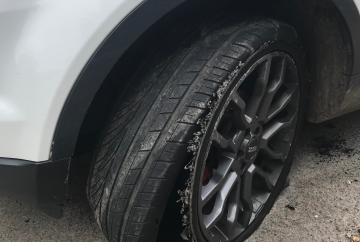
Amanda Stewart's cracked tyre due to pothole damage
A VILLAGE near Henley is suffering ongoing issues with potholes, reminiscent of a “third-world country”.
© Copyright 2024 Baylis Community Media CIC All right reserved