08:28AM, Thursday 04 January 2024

A RUGBY player whose girlfriend saved his life after he suffered a cardiac arrest is campaigning for greater awareness of CPR.
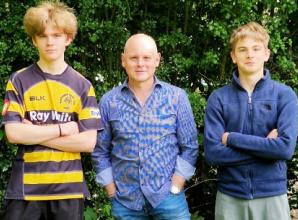
Morgan MacRae, from Peppard, who plays for the Henley Hawks, was given CPR by Kitty Williams in bed as she waited for paramedics to arrive.
She was able to remember the training she received at school and university and was told later by doctors that her swift action had saved his life.
The couple, who are both 22, are now working with charities to introduce training workshops and educate the community on how crucial CPR can be.
The incident happened at Morgan’s brother’s house in Wimbledon on August 13 where they had met up after going to London separately to see friends.
Miss Williams, of Greys Road, Henley, said: “We were home alone as none of his brother’s housemates were there. I had never been there before so didn’t know where we were. We had a normal evening and went to bed just like normal. It had just gone 6am the next day when it seemed like Morgan was snoring but he wasn’t — he was inhaling really quickly and exhaling strongly. It woke me up and I was saying: ‘Morgan, Morgan’. Nothing, no response.
“I was shaking and shaking him and still nothing. I was saying to him: ‘I’m going to call the ambulance; you’re freaking me out. Just stop.’ I didn’t know he was unconscious at the time.
“He was sitting up slightly and I was looking at him telling him to stop being silly. I was shaking him and he actually fell out of the bed. I ran over to him and was saying: ‘Morgan, Morgan’ and his head just slumped back. It was like he was dead.
“He’d just stopped breathing. His heart wasn’t pumping and his face went blue and his eyes rolled back and there was nothing.
“I screamed and called 999. They were great. I was on the phone to them and I had no idea where I was. Thank goodness his brother lives at the end of the road because I looked out of the window and saw the street sign. I didn’t know what number it was.
“They said: ‘You need to start giving him CPR’. I gave him CPR for seven to eight minutes while waiting for the ambulance.
“Five ambulances turned up and paramedics all came running upstairs. I stayed downstairs while they went upstairs, one after the other, and different crews kept coming in.”
Doctors had to defibrillate Mr MacRae four times before they could revive him. He was then taken to St George’s Hospital, Tooting, by ambulance with Miss Williams following in a paramedic’s car.
She said: “I was so terrified. I felt so completely alone.”
Both her parents and Mr MacRae’s parents drove to the hospital.
Miss Williams said: “The stars aligned because we were five minutes away from the best cardiology hospital in the UK. It was incredible.
“When I got to the hospital, all the doctors were coming out to ask me about what happened and why but I said I didn’t know.”
Mr MacRae was put into an induced coma for two days. It was uncertain whether he was going to wake up again.
Miss Williams said: “We didn’t know how he was going to respond. Originally, we were told the doctors were not even going to try to wake him up for three days.
“None of us slept. My school friends came to make sure I was okay. We were sitting in the hospital and got a call at around 10am and we all said: ‘Why would they call us? It’s not going to be good news.’
“So me and his dad and mum were walking upstairs, none of us wanting to put one foot in front of the other.
“But this nurse turned around and said to us: ‘He’s more excited to see you than you are.’ We were like: ‘What?’
“We ran into his room and he was awake and we all collapsed on the floor crying our eyes out and clinging on to the nurses. It was just the best feeling ever.
“A nurse told us: ‘There’s a whole haul of angels in this room because the only reason that boy is awake is down to him’. It was amazing he was here.”
Mr MacRae spent a week in intensive care before being moved to the cardiac ward for two weeks, where he underwent surgery to have a special device fitted.
The subcutaneous implantable cardioverter-defibrillator detects arrythmias and sends an electrical shock to the heart, changing the rhythm back to normal.
It is fitted on the left side of the chest next to the ribcage under the skin and is changed every eight to 10 years.
Mr MacRae also has a monitor at home which sends signals back to the hospital weekly.
Miss Williams said: “The biggest thing I keep telling myself is that he’s here and that’s all that matters.
“What I found really hard was when he was in the ICU and we didn’t know if he was going to live or not.
“We were all in the waiting room with his brother and his girlfriend and his mum and dad and me. Everyone had their person who, in moments of crisis, makes you feel safe and realise everything’s okay but my person was the one who wasn’t there and I didn’t know if I was going to speak to him again. That was so hard.
“I just wanted to see him and for him to see me and to tell him I loved him.”
She said that breaking the news to his parents on the phone earlier had been awful.
Miss Williams said: “I didn’t know what was really happening and I was in crisis. Your world just falls apart and you don’t know what’s going on.
“And to tell someone’s parents that their son is unresponsive — I wouldn’t wish that on my worst enemy.”
She said she was grateful for the CPR training she had received, first at Rupert House School in Bell Street, Henley, and later at Oxford Brookes University, where she was captain of the lacrosse team so received training on how to use a defibrillator and perform CPR.
She said: “I’m so grateful. The fact I was taught CPR meant the difference between Morgan surviving and not. I didn’t know how crucial CPR is.
“For the rest of his family, for his friends, whatever, it was down to me to make sure he was okay and that’s a lot of pressure. I am really glad that I knew what I was doing.”
Mr MacRae doesn’t remember what happened nor his first week of being in hospital. His family didn’t tell him about the cardiac arrest then to avoid scaring him.
He said: “It was a bit of a mess for the first two or three days and they had to keep telling me what had happened over and over again.
“I don’t know if it was my brain going into a coping mechanism and not remembering all the bad stuff.
“As soon as I knew I was going to be okay and I was over the worst of it, that’s when I started to remember.”
Miss Williams said: “When he woke up, it was really emotional for all of us. We said: ‘Don’t worry, you’re safe, you didn’t do anything wrong. It’s fine.’
“Then a nurse came in to do some tests and said: ‘So obviously when you have an out of hospital cardiac arrest…’
“Morgan looked at us so we said: ‘We’ll tell you later’. Then we had to tell him everything that had happened.”
He came home on September 2, where he continued his recovery and adjusted to the implanted device.
He started training with Henley Hawks again three weeks later but he mustn’t experience extreme temperatures, play certain sports or scuba dive.
MacRae is working with a Dutch company to develop protective equipment that will allow him to play contact rugby again with his implant, making him the first rugby player in the world to do so. He hopes to be back playing by February.
He is grateful to his cardiologists, world-renowned doctors who have been working with World Rugby to approve his return.
The couple want to raise awareness of the importance of CPR.
Mr MacRae said: “We’re trying to get as many people talking about CPR as possible, whether that be in schools or in sports clubs or just on the high street.
“Our end goal would be to get a first aid course implemented as part of a driving test theory exam because we think it’s one of the easiest ways to teach people across all ages while increasing road safety.
“About 2.5million people a year do a theory test and then 1.5million go on to do a practical test. Even if they’re not driving and they witness something while walking down the road or they’re playing sport or they’re in school, it just means that the public are a lot safer and a lot more equipped with being able to deal with these types of situations.”
Miss Williams added: “The biggest message that we want to get across to people is you don’t know when this will happen. You could be sitting having your Sunday roast with your family or you could be walking down the street and it happens to a random stranger.
“You want to be able to confidently help someone. You never want to be in a moment of crisis and be helpless, not being able to save your mum or your sister or your boyfriend or just a random person.
“You should always be able to feel comfortable enough that you could help save someone’s life and never feel responsible that you were helpless in that situation.”
Every year, 30,000 out of hospital cardiac arrests happen in the UK and the survival rate is less than eight per cent.
Mr MacRae said: “You’re never going to save everyone but if we can raise that statistic a little bit and it means more people are able to make it through and get back to their daily lives, that would be our aim.”
They have set up an Instagram page called @mysicdandme to share their journey and allow people to get in touch and talk about their stories and raise awareness. The page already has more than 1,000 followers.
Mr MacRae said: “People contact me on a daily basis thanking me for sharing my story and others have contacted me about sponsored walks and fundraising ideas for cardiac-related charities.”
He is working with a charity called Code Blue CPR, co-founded by David Sullivan, from Surrey, who set it up after losing four of his friends under the age of 45 to cardiac arrests.
Mr MacRae wants to help make Henley a “heart-safe” town. Thanks to the charity Millie’s Dream, 100 defibrillators are located around the area but Mr MacRae wants to take it further by inviting Mr Sullivan to train high street workers and members of the public to use them and conduct CPR confidently.
He said: “That means that if anything ever happened in Henley, there are 200 people who are confident enough to respond and hopefully save someone’s life.”
Miss Williams said: “It’s so easy to learn — it takes half an hour to learn and is something everyone should do.”
Mr MacRae said: “I was never taught it at school. Kitty is lucky she was taught at school but I’ve spoken to all my friends and my family and none of us was taught.
“We want to start here and then go bigger and go into different schools around the country and teach as many people as we can.”
Most read
Top Articles
A MAN from Henley was arrested on suspicion of murder on Sunday after a man was seriously injured in Dorset and later died in hospital.

SUPERMARKET chain Aldi has confirmed that it plans to open a new food store in Henley. The Henley Standard revealed in May last year it was looking at the Jewson site, off Reading Road, with the materials firm set to move to the former Gibbs and Dandy...
Rev Sue Morton, who has served Fawley, Fingest, Frieth, Hambleden, Medmenham and Turville since 2012, is leaving on Sunday February 1.
© Copyright 2024 Baylis Community Media CIC All right reserved