07:34AM, Monday 25 March 2024

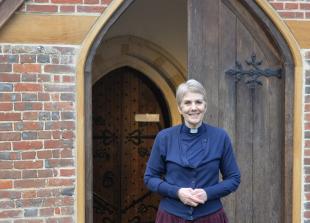
AN HISTORIAN who has dedicated herself to studying Henley’s oldest buildings has been awarded the town medal.
Ruth Gibson, 85, of Vicarage Road, is secretary of the Henley Archaeological and Historical Group.
She has been giving her time freely for about 40 years, recording and interpreting the early buildings of Henley.
She was presented with the award by Mayor Kellie Hinton at a ceremony in the town hall on Monday while surrounded by family, friends and town councillors.
After accepting the medal, Mrs Gibson gave a talk on some of the town’s oldest buildings and her work to date them.
One of her biggest projects has been a dendrochronology project which enables buildings to be dated to the exact year of construction.
Her work has also facilitated the listing of buildings with English Heritage and she has often improved or corrected the initial descriptions.
Mrs Gibson moved to Henley after marrying her late husband Bill who was a town councillor.
In the early Nineties, she and Ann Cottingham composed a detailed survey of streets bordering Market Place, Bell Street and King’s Road in response to a development plan.
As a member of the Henley Archaeological and Historical Group in the early Eighties, she organised its vernacular building research project to record pre-1940 houses and farm buildings in Henley and this part of the Chilterns.
She is also involved in the Society for the Protection of Ancient Buildings’ reports on barns and her work has been sent to the National Monuments Record and the Oxford County Museum at Woodstock.
Mrs Gibson made significant contributions to the definitive Victoria County History of Oxfordshire and Simon Townley’s book Henley on Thames, Town Trade and River, which was published in 2009.
She obtained a degree in archaeology and ancient history at the University of Reading in 1989, basing her dissertation around the village of Harpsden.
She previously worked in architectural conservation for Bedfordshire County Council for 10 years and in her retirement has worked for the National Trust. David Feary, who nominated Mrs Gibson for the award, said her depth of knowledge, particularly of vernacular timber-framed buildings, had enabled her to make an “exceptional” contribution to Henley.
She had created greater awareness of the town’s unique heritage, communicating this to the wider community and working hard to ensure that it is appreciated and protected.
Mr Feary said: “She has raised her family in Henley, pursued her historical interests here, made a huge contribution and created a lasting legacy for the town.”
Councillor Hinton told Mrs Gibson: “It’s fair to say that there is nobody in this town who knows more than you about Henley’s historical buildings.”
She told the gathering: “Ruth has been giving her time freely for nearly 40 years and does a lot of recording and interpreting of the early buildings of Henley to preserve our heritage, keep it alive and spread that information going forwards to the new generations.
“Her dendrochronology project — tree ring dating — enables buildings to be dated to the exact year of construction.
“This is something that I’ve been really happy to contribute towards with my South Oxfordshire District Council councillor grant because it is just fascinating the work on Bell Street, the Relais hotel and other buildings.
“Detailed reports on more than 100 buildings are already available on the Henley Archaeological and Historical Group website, with more to follow.
“The original hard copies will be deposited in the county archives at Oxford for future historians. Ruth’s work has facilitated the listing of buildings with English Heritage and she has often improved or corrected — that doesn’t sound like you, Ruth — their initial descriptions.
“She has also made extensive contributions to the 150 newsletters and the 33 printed journals of the Henley Archaeological and Historical Group, all to a professional standard.
“Ruth has developed an incomparable knowledge of the medieval architectural history of Henley and the surrounding area.
“In the context of planned development in Henley, Ruth has kept a protective eye on the town’s historic buildings and regularly provides expert responses to applications that affect historic buildings.
“Very recently, this has included documents and informed comment regarding the ownership of the slipway, the Grade I listed bridge, the Red Lion Hotel and the location of the proposed hotel.
“Currently, as secretary of the group, Ruth continues to be involved in research, writing articles and letters, giving lectures, organising visits and keeping the membership informed about historical activities over a wide area.
“She has always shared her unique knowledge very generously.
“During Bill’s years on the town council, especially when he was chairman of the planning committee, she provided a vast amount of knowledge and background information, as she has also done for various public inquiries.
“She continues to offer her expert knowledge to the town council and to the Henley Society when one of the 200 listed buildings becomes the subject of planning applications. Can I just say, we are so grateful for the work you do in helping the town council and the Henley Society.
“Ruth continues to work closely with Dr Dan Miles, an expert on dendrochronology, to date the town’s earliest buildings, revealing further architectural treasures hidden behind more recent buildings.”
After accepting her medal, Mrs Gibson gave a presentation on various historical buildings in the town, including a private house in Bell Street and the Zizzi’s restaurant premises in Hart Street.
Her daughters, Natascha and Tanya Gibson, said they were proud of their mother.
Natascha said: “She has always been into buildings. There isn’t anything she doesn’t know about Henley buildings.
“I think the great thing is it’s not just the building, it’s the people. She makes sure that people are interested in the history of their buildings and want to be part of it. I think she has met a lot of people via that.
“It’s lovely to know that if mum hadn’t done it, Henley wouldn’t have it.
“Like she said, there were a lot of people who helped and worked with her but she has always been the one that drives it and wants to know the truth.”
Tanya added: “I remember as a young child, we used to go up to Harpsden woods.
“They had an archaeological dig up there and she and our dad were very interested in it.
“She has always been interested in it. Our dad would have been really proud of her. They were very much together on it.”
Mrs Gibson said her efforts had already been recognised by bodies, including record offices and societies.
She said: “This is a nice addition and it’s wonderful. Hopefully, the town council and people in Henley will just look at the buildings because I’ve particularly shown the buildings which are hiding something.
“A building tells you so much about the history. When you’ve got a date, you think: ‘What happened in 1365? How did they have so much money to produce it?
“One of the buildings was built when the plague was and you just think everybody died and nothing happened but one of the buildings was built at that time so it tells you a lot about what was going on at that time.”
Most read
Top Articles

SUPERMARKET chain Aldi has confirmed that it plans to open a new food store in Henley. The Henley Standard revealed in May last year it was looking at the Jewson site, off Reading Road, with the materials firm set to move to the former Gibbs and Dandy...

FAMILIES who spent generations camping on an island in Shiplake are “heartbroken” now that the site has gone on the rental market. Former plot-holders at Shiplake Lock Island say that the Environment Agency, which owns it, have allowed it to...
© Copyright 2024 Baylis Community Media CIC All right reserved