10:30AM, Monday 30 October 2017
MEMBERS were given a talk on photographer William Henry Fox Talbot at the October meeting.
Martin Andrews, a lecturer in graphic communications and the history of printing at Reading University, spoke about Fox Talbot, a pioneer on photographic techniques, and his printing factory, the Reading Establishment.
Mr Andrews explained the origins of photography, from early machines used by Renaissance artist Leonardo Da Vinci for scientific investigation to modern prototypes in the 19th century.
He also spoke about the chemical process used to produce the first photographs, with pioneers struggling to create and maintain permanent images captured by the first cameras. Fox Talbot was one of the first people to claim he had made a picture using light, using sensitised paper in small cameras around his home at Lacock in Wiltshire.
One left for several hours in August 1835 showed a negative image of his oriel window.
He realised that if he waxed this piece of paper, sandwiched it with a second piece of coated paper and exposed that to the light through the negative, he could get a positive and by repeating this could form multiple copies, a breakthrough at the time.
To develop his technique, Fox Talbot set up the Reading Establishment in Russell Terrace, Reading, halfway between his home and London and now part of Baker Street.
His valet, a Dutchman called Nicolaas Henneman, began to produce pictures on an industrial scale with the idea being to show what was possible with the new process, including recording works of art for insurance or 3D items such as sculptures, or simply creating artwork.
Once negatives were made, the prints were exposed for about 20 minutes in frames set up outdoors.
The Establishment created about 50,000 prints over three years, while Henneman also took many pictures of Reading which were on sale at Lovejoy’s, the establishment’s paper merchant.
The first book in the world to include photographs, The Pencil of Nature, was partly produced at the Reading Establishment and included pictures by Fox Talbot and Henneman.
Despite the ground-breaking effect on photography that Fox Talbot’s work had, the Government showed no interest in it and the premises today does not even having a blue plaque marking its heritage or a display in the town’s museum.
The society’s next meeting will be on Tuesday, November 14, when John Harrison, who leads the team of bell ringers at All Saints’ Church in Wokingham, will talk about the history of bell ringing.
On Tuesday, December 12, the society will hold its Christmas party.
Meetings take place at the Old Pavilion on the recreation ground, off Recreation Road, from 8pm.
For more information, call Peter Delaney on 0118 940 3121 or visit www.wargrave
history.org.uk
Most read
Police cordon on the scene at Phyllis Court Drive
Top Articles
Police cordon on the scene at Phyllis Court Drive
A 44-year-old man from Henley was arrested and remains in police custody following the death of a woman, who has not been formally identified, in Phyllis Court Drive.

Stock image
Flood warnings are in place on stretches of the River Thames following a period of heavy rainfall.
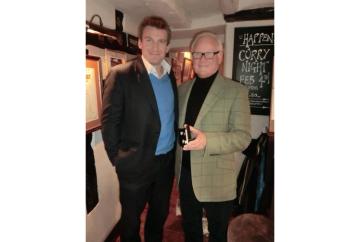
Brakspear chief executive Tom Davies (left) with William Dobson
WILLIAM Dobson, known as Bill, was for more than 40 years a familiar and respected figure in Henley.
© Copyright 2024 Baylis Community Media CIC All right reserved