05:11PM, Wednesday 25 January 2023

VOLUNTEERS have constructed a temporary barrier to prevent migrating toads from being killed by traffic on a busy main road.
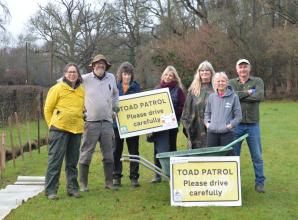
About 20 members of the Henley Toad Patrol spent Sunday morning building the 489m long barrier using wooden stakes and plastic sheeting.
The group do this every January in Oaken Grove Wood, with permission from the Culden Faw Estate, which owns it.
The barrier prevents toads, frogs and smooth newts from crossing the A4155 Marlow road, which separates the wood where the frogs live from their spawning ponds in the grounds of Henley Business School.
Every night from February to April, volunteers will return to patrol the barrier and pick up any amphibians, which are then safely carried over the road in buckets and placed by the pond.
Angelina Jones, 56, who
co-ordinates the group, said: “We’re gearing up for migration 2023, putting up the barrier before they start moving. They won’t move yet as it’s too cold. It needs to be more than seven degrees at dusk for toads to move. Normally it’s at the start of February.
“On very busy nights we’ll move 1,500 toads. We may have up to 25 volunteers from dusk until midnight. They’ll be in high vis jackets and when it’s safe they’ll go over the road.
“We’ll walk the toads up to the pond and leave them to go in, then come back and do another bucket.
“We have toad patrollers at either end of the barrier, about three or four, to get any toads off the road. In the past we were losing 10 to 15 per cent that way and now it’s down to five per cent, although that’s still five per cent too many.”
Henley Toad Patrol was formed in 1987. Since 1999, when
co-founder Professor John Sumpter, of Brunel University, started recording nightly numbers, the group has helped more than 126,000 toads across the road.
On average, the group move 5,475 toads each year. Last year, they helped 5,901 toads, 1,243 frogs and 240 smooth newts to reach their spawning pond safely. Ms Jones said: “Without the group, the whole toad population would be quickly decimated.
“We’ve got a strong volunteer group which works really well. Everyone is very dedicated.
“There’s a WhatsApp group so on busy nights we can say, ‘Please come down, it’s very busy’ and on other nights people can message, ‘Should I come?’ and someone down here will say, ‘No, it’s quiet, stay at home.’
“Some people come for half an hour after work, some people stay until midnight. People come for as long as they can.”
Ms Jones has been a member for more than 20 years and said: “I’m a local girl and knew it was a problem. I would turn up after work.
“It’s great to help wildlife overseas, to hop on a plane and help orangutans in Borneo, but we need to help local wildlife.”
She says that still not much is known about toads and that more research needs to be done. “They’re not an animal people pick to study,” she said. “Maybe people think they have an image problem. That’s our problem, not theirs.”
Cathy Holwill, who has carried the most toads across the road of anyone in the group over the nine years in which she has been volunteering, said: “We got funding from Biffa to create new ponds in the woods here.
“We put some toads in it every year. We’ve been seeding it for three years now, so hopefully we’ll start to see more toads returning to it rather than crossing the road. It’s also a precaution in case something happens to the other lake.”
Matthew Beesley, from Wallingford, was taking part in the construction of the barrier for the fourth year.
He said: “I do lots of conservation stuff. It’s fun to get out and about, even though it’s often wet and wild and windy, the conditions the toads like. It’s very beautiful out here.”
The barrier is taken down at the end of every migration in April.
Most read

New look: a computer generated image of an enlarged fitness centre and spa at Phyllis Court
Top Articles

SUPERMARKET chain Aldi has confirmed that it plans to open a new food store in Henley. The Henley Standard revealed in May last year it was looking at the Jewson site, off Reading Road, with the materials firm set to move to the former Gibbs and Dandy...

FAMILIES who spent generations camping on an island in Shiplake are “heartbroken” now that the site has gone on the rental market. Former plot-holders at Shiplake Lock Island say that the Environment Agency, which owns it, have allowed it to...
© Copyright 2024 Baylis Community Media CIC All right reserved