09:30AM, Monday 12 January 2026
I USED to worry about talking about God, church or religion. I had always been told that these topics, like sex and politics, were best avoided in polite company. But things have changed. While fascism and fornication may still provoke discomfort, faith keeps cropping up in conversation.
Even celebrities are doing it. Whether it’s Gabriel Jesus celebrating a goal for Arsenal by revealing a T-shirt declaring “I belong to Jesus”, Alisson Becker speaking openly about his Christian faith at Liverpool, or Jérémy Doku being baptised after a Manchester City match, public expressions of faith are becoming harder to ignore.
At the same time, pundits and politicians are increasingly invoking God and Christianity in public debate, sometimes competing over who can sound most authentically faithful. Even if they are wolves in sheep’s clothing, and even when it amounts to little more than rhetoric, it still marks a noticeable shift in tone.
The data reflects this change. A recent Savanta survey found that around 45 per cent of the UK population planned to attend a church service or event over Christmas, with particularly strong interest among younger generations. Booksellers are also reporting a sustained rise in Bible sales in recent years — in some cases by as much as 87 per cent over five years.
Perhaps this renewed curiosity about faith is not surprising. We live in a world facing the growing threats of war, climate catastrophe and pandemics, while many of us struggle with financial pressure, mental health challenges and fractured relationships. More than ever, people are searching for hope, meaning and purpose.
Faith offers this in spades. At its best, it gives people a story big enough to live inside, a community that welcomes rather than excludes, a future that exceeds expectation, a task that brings people together, and a family that embraces even the most broken.
The Christian faith is no longer widely dismissed as a crutch for difficult times, a collection of platitudes for the naïve, or a magic wand to remove our problems. Instead, it is being rediscovered as a resource for facing the future — and as a challenge that inspires. It calls us to love when it is costly, to forgive when it hurts, to sacrifice personal comfort for the sake of the vulnerable, and to give generously in a culture that encourages us to grasp tightly.
It urges hospitality towards the lonely, the refugee and the vulnerable, and invites us to care for our neighbours, wherever they have come from. It offers a moral compass — not as a weapon to win arguments, but as a framework for living well together. It insists that every person has dignity, regardless of status or background; that truth matters, even when it is inconvenient; and that power exists to serve, not to dominate.
These are not soft or sentimental ideas. They are demanding, sometimes uncomfortable, and often run against the grain of our culture. And yet there is something intrinsically attractive about them: a movement seeking to recreate the world as it was always meant to be.
In and around Henley, our churches are slowly but surely growing — not only numerically but, as communities made up of people ranging from curious to committed, rediscovering the message of the Bible together and demonstrating that faith still has something vital to offer our shared life today.
Dr Krish Kandiah OBE is a theologian, broadcaster and charity founder
Most read
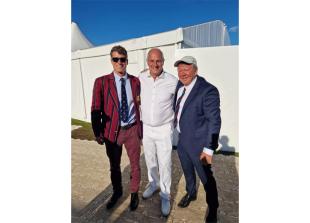
Richard Spratley (right) alongside Sir Steve Redgrave and Henry Bailhache
Top Articles

A MAN from Henley was arrested on suspicion of murder on Sunday after a man was seriously injured in Dorset and later died in hospital.

Stock image
Flood warnings are in place on stretches of the River Thames following a period of heavy rainfall.
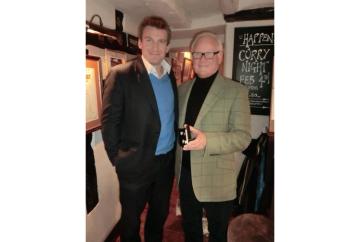
Brakspear chief executive Tom Davies (left) with William Dobson
WILLIAM Dobson, known as Bill, was for more than 40 years a familiar and respected figure in Henley.
© Copyright 2024 Baylis Community Media CIC All right reserved