09:30AM, Monday 05 January 2026

A WILDLIFE photographer said a baby hare he caught on camera was among his rarest sightings to date.
Simon Booker, 62, got to the prairies in Ipsden Road at dawn, where he spent more than three hours laying in a tractor rut in camouflage clothing.
Mr Booker said that while seeing a leveret is unusual, they are even harder to get close to and photograph.
He said: “I laid down flat and put the camera on the tripod so I was eye level with the animal, which is really, really important.
“I waited for any hare to pop out and, as it happens, it was a leveret, which is really rare because they run like hell within a few weeks of being born.
“His feet were a bit big and dumpy because it was still a baby and it kept coming towards me and that was really exciting because every step it takes, you’re thinking, ‘can I get the picture?’
“You have to control your breathing and not get too excited or twitch too much.
“You get that surge of, ‘bloody hell, this could be my perfect picture today’ because that was a perfect set-up.”
When he came back to his home in South Stoke to upload the photographs, he was pleased at how sharp they were.
“It was huge elation,” he said. “When you’ve spent hours waiting to take one picture for four seconds and you have that, it’s so worth it.
“Even when you machine gun [the camera] and you take
20 frames a second of it running, you have that excitement as to how good it will be.” Mr Booker, who is married with three children, works in sales management but found his love for photography about seven years ago.
He now selects his best shots for a charity calendar in aid of the Stroke Association after he suffered the condition three years ago.
He was previously diagnosed with atrial fibrillation, which is an irregular heartbeat.
This year, he has named his calendar “Wild Connections” as he describes each photograph as an “eye to eye moment” with a wild animal.
Many of the calendar’s shots are taken within a five-mile radius of his home including in Stoke Row, South Stoke and Streatley.
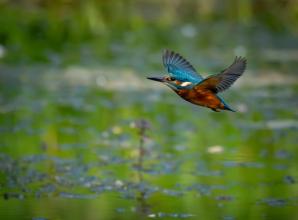
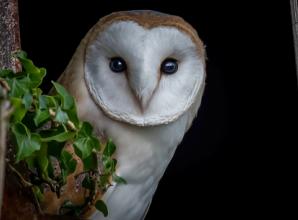
Photos include a red fox in Stoke Row, a muntjac fawn and a kingfisher, both captured in South Stoke, a barn own in Streatley, a fallow deer in Otmoor nature reserve and a roe deer, also taken in Stoke Row.
He said: “My main criteria for the calendar has not been a ‘best of Simon Booker’. In the last year it has been the best of British.
“The front has the picture of the roe deer.
“It was 4am and I was actually going out to photograph badgers but I looked to my right and there was this beautiful roe deer stood watching me in a field.
“I was walking along the path and she didn’t hear me coming because the path was overgrown.
“She was thinking, ‘what the hell are you doing at this time?’.”
Mr Booker then rattled off dozens of photos in the hope he would get at least one sharp image.
He recalled: “It was almost dark but one of them came out really, really sharp.
“You could see her eyeballs and if you look closely, you can more or less see me in the reflection.
“It was a pure reaction shot. The payback was that it was sharp and then the payback on top of that was the light was fantastic as well.”
Mr Booker uses a pop-up hide to take pictures without being seen.
He recalls a time he received a tip-off about otters near the South Stoke slipway which feature for November.
He said capturing them is a recipe for “being difficult”.
“They spend a lot of time hunting in the night,” he said. “Getting a flash out is very complex and I’m an ethical photographer so I don’t particularly want to do that if I can avoid it.
“They live in a holt and that has an underwater entrance and they go in and out of their house underwater.
“If they see you, seven times out of 10 they will skive so your chances of getting a photograph of one are low. This one was very special for me personally because I learned my fieldcraft and I knew otters generally hung around near the edge of the river.
“Also, I was looking at the reeds so I saw the reeds move and I thought, ‘something’s coming and it's too big to be a moorhen’.
“Then I saw ripples which is when I saw it diving up and down.
“That’s when I knew it was an otter and I got a sneak peak of it coming down the river so I went into one of the fisherman’s pegs and I got an angle on it.
“I had about four or five of these moments where I could take photos of the otter.
“At the end, it was actually looking at my dog because I often take pictures while walking the dog.
“It looked at the dog a couple times and then disappeared.
“It was a product of my technique and getting better at that and my fieldcraft to even see one and then it’s about the execution.”
Mr Booker chooses his photos based on variety, quality and popularity.
He said: “I usually get home with 300 or 400 pictures. Then I think, ‘what are my five best ones?’
“I then choose the five best ones and choose two or three I’m going to work on and spend
20 minutes on each one.”
Mr Booker has raised more than £3,000 for the Stroke Association so far through sales of his calendar and wildlife talks he has hosted in South Stoke and surrounding villages.
The Wildlife Connection calendar costs £15 from www.stokerpix.square.site
Most read
Top Articles
CONCERNS have been raised about the future of a shop and post office in Shiplake after it was put up for sale. The property in Station Road has been listed for sale with a leasehold for almost £150,000. Owners, father and son Andrew and Archie...

AN event held to bring together people who would otherwise be alone on Christmas Day returned to Henley after a five-year hiatus. The “Jingle and Mingle” event welcomed 80 guests to the Christ Church Centre in Reading Road to share a three-course meal...

© Copyright 2024 Baylis Community Media CIC All right reserved